
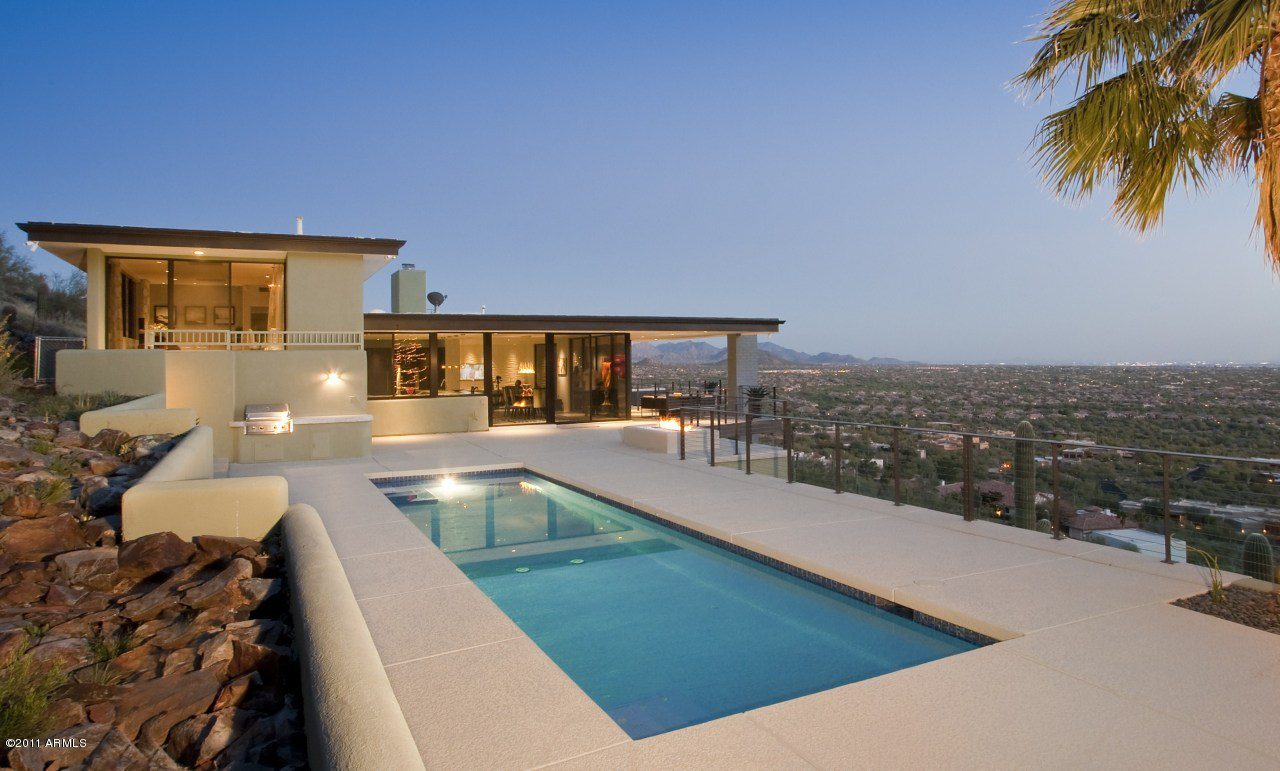
Perched on the southern slope of Black Mountain in Carefree, Arizona, the Martin Home is a custom modern residence designed by Eric Spry of Spry Architecture. This hillside home embraces the steep terrain, integrating with the natural desert topography while capturing sweeping views of Phoenix city lights to the south. Featured on HGTV’s Bang for Your Buck, the Martin Home exemplifies modern desert architecture that merges bold design with climatic sensitivity.
A Desert Retreat Looking Toward the City
The Martin Home occupies an unusual position in the Spry Architecture portfolio. It is a house on Black Mountain that doesn't look primarily at Black Mountain. Instead, the approximately 4,000-square-foot residence occupies the mountain's southern slope and looks outward across the Phoenix metropolitan valley. That inversion shaped the project. The clients could live within the rugged physical environment of Carefree while maintaining a visual relationship with the city stretching across the distance below. The architecture needed to reconcile those two worlds. Immediately outside: rock, slope and Sonoran Desert. Farther away: streets, buildings and the illumination of metropolitan Phoenix. Martin was designed for the territory between them.
Black Mountain Underfoot
It's the ground. The steep southern slope creates a physical condition that is immediate and unavoidable. The house must negotiate changing elevation while its principal outlook moves away from the mountain toward the broad valley to the south. That creates an unusual reversal. From many Carefree properties, Black Mountain is the destination of the view. Here, the occupants are already on it. The landscape close to the house is therefore experienced differently from the landscape in the distance. Nearby, the mountain is tactile—rock, grade, vegetation and the changing ground plane. Beyond it, Phoenix reads almost abstractly across the valley. The architecture occupies the point where those two scales meet. One can be measured in feet. The other in miles.
Holding the Mountain, Facing the Valley
The steep site creates two fundamentally different sides to the residence. Toward the mountain, architecture must negotiate ground. Toward the valley, it can open. That difference gives the house its basic disposition. Rather than treating every elevation equally, Martin responds to what is immediately outside each side of the building. The uphill condition provides enclosure and proximity to the terrain, while expansive glazing toward the south takes advantage of the long view across metropolitan Phoenix. The result is a house with two very different senses of distance. On one side, Black Mountain presses close. On the other, the ground visually falls away. The architecture mediates between those conditions rather than attempting to make them alike. That asymmetry is fundamental to living on a steep slope. The mountain provides the weight. The valley provides the release.
A Southern View Comes with a Southern Sun
Martin's most expansive outlook is also its most environmentally demanding. Opening the residence south toward Phoenix introduces abundant daylight but requires the glazing to be protected from Arizona's solar exposure. High-performance glass forms the transparent edge toward the valley, while deep roof projections limit direct sun before it reaches the enclosure. The relationship between those elements allows the southern elevation to remain visually expansive without leaving the interior unprotected. The strategy is straightforward because the orientation is straightforward. The house wants to look south. The sun arrives from the south. The architecture has to negotiate both. A restrained exterior palette keeps attention on larger relationships—mountain, shadow, glass and distance—rather than relying on decorative material changes to give the house identity. As sunlight moves across the southern face, the overhangs deepen the shadow immediately around the building while the valley beyond remains exposed to the Arizona sky. The contrast reinforces the position of the house: protected at the mountain, open toward the city.
When the Valley Becomes the Night View
Martin has two different landscapes, but it also has two different clocks. During the day, Black Mountain is the more immediate presence. The slope, desert vegetation and surrounding rock establish where the house physically belongs. Looking south, the valley stretches away beneath the brighter desert sky. After sunset, the hierarchy changes. The mountain darkens. Phoenix appears. Individual streets and buildings begin to register as points and lines of light across the valley, transforming what had been distant geography into an illuminated metropolitan field. The house remains in the desert, but its visual relationship with the city becomes stronger as night arrives. That daily reversal is central to Martin. It isn't completely a mountain retreat, because the city is always part of its outlook. And it isn't an urban house, because its immediate physical world is Black Mountain. It belongs to the threshold between the two. By day, Martin inhabits the mountain. By night, it looks across Phoenix.
Project Index & Credits
- Architecture Firm
- Spry Architecture
- Location
- Carefree, Arizona
- Completion Year
- 2011
- Area / Dimensions
- 4,000sq ft
- General Contractor
- Craig Eckhardt
- Photography
- Spry Architecture
Project Gallery (12)
Explore Comparable Works
Inspired by Martin Home?
Discuss your property, site topography, and custom modern residential vision directly with Eric Spry, AIA.