
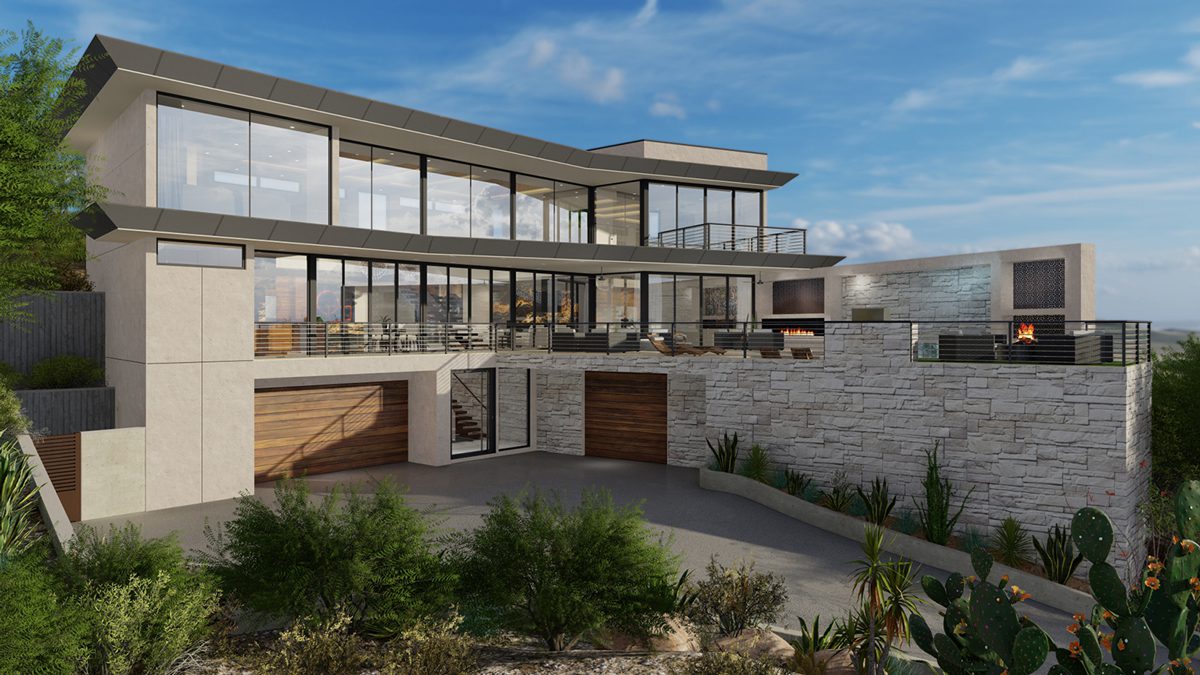
Perched on a scenic hillside in Phoenix, Arizona, the Fisher Molaver Home is a modern desert residence designed by Eric Spry of Spry Architecture. With three levels carefully stacked into the slope, this home captures extraordinary views of the western mountains, Sonoran sunsets, and the city lights of downtown Phoenix.
Making a Compact House Feel Expansive
The Fisher Molaver Home began with a substantial program and a relatively compact footprint. At approximately 3,000 square feet, the house needed three bedrooms, three-and-a-half bathrooms, a media room, generous social spaces and a strong relationship with outdoor living. The hillside offered another kind of square footage. Not land to occupy. Elevation to use. Rather than spreading the program broadly across the slope, Spry Architecture organized the residence vertically over three levels. That strategy reduces the amount of hillside occupied by the house while allowing different rooms to participate in the changing views created by elevation. The objective wasn't to make 3,000 square feet behave like a much larger house. It was to make every level participate in something beyond its walls. The hillside supplied the dimension the footprint could not.
Between Desert and Downtown
The Fisher Molaver property occupies a particularly Phoenix condition. Look outward in one direction and the landscape belongs to the Sonoran Desert—mountains, sky and the long horizontal light of western sunsets. As evening arrives, another landscape appears. The city. Downtown Phoenix begins to register in the distance as buildings and streets illuminate below. The site therefore exists between two identities that often define Phoenix itself: metropolitan city and desert landscape. Spry Architecture uses the hillside to engage both. The slope raises the house above its immediate surroundings, extending sightlines toward the western mountains while allowing the city to become increasingly present after dark. During the day, distance is measured by mountains. At night, it is measured by lights. The architecture remains between them.
Building Up Instead of Out
A hillside can encourage a house to become long. Fisher Molaver takes another approach. Three levels are stacked into the slope, allowing the program to climb rather than spread. The organization gives each floor a distinct elevation and relationship to the surrounding landscape while maintaining a relatively compact overall footprint. That vertical arrangement also helps separate uses. Bedrooms and private spaces can occupy their own positions within the section, while the great room becomes the social center of the house. There, the architecture changes direction. Instead of continuing vertically, the great room extends horizontally toward the covered poolside patio. Large areas of glass and sliding doors connect the interior to the exterior living space and pull the eye beyond the pool toward the larger landscape. The house therefore operates along two axes. The hillside organizes it vertically. The view releases it horizontally. That opposition gives a relatively compact residence much of its spatial character.
Opening a Hillside House to the West
The same western orientation that provides sunsets and mountain views also brings intense afternoon light. At Fisher Molaver, openness therefore requires protection. The covered poolside patio creates a shaded zone beyond the great room, extending usable living space outside while establishing a buffer between the interior glazing and the western sky. Glass walls and large sliding openings maintain the visual connection through that shaded threshold. When opened, they allow air and movement to pass between the great room and exterior living area; when closed, the landscape remains visually present. The hillside itself contributes another condition. Because the residence is organized across multiple levels, different portions of the house meet the terrain differently. Some spaces are more closely held by the slope, while others gain greater exposure as the house rises. That variation creates a natural rhythm between enclosure and openness. The architecture doesn't treat the hillside as a platform. It uses the changing elevation to determine how each part of the house meets the land, light and view.
The Desert Above the City
Fisher Molaver changes as you move vertically through it. At one level, the hillside is immediate. At another, the horizon begins to open. Higher still, the relationship with the surrounding city and distant mountains expands. That progression makes elevation part of the experience rather than simply a technical response to slope. The great room provides the moment when the house opens most completely. Interior space extends toward the covered patio and pool, and the horizontal landscape becomes dominant. Then the light changes. The western mountains move into silhouette. The desert sky takes on the color of sunset. And eventually, downtown Phoenix and the city below begin to illuminate. The same view becomes something different. That transformation gives Fisher Molaver an identity distinct from a remote desert hillside house. It belongs simultaneously to the natural and metropolitan landscapes of Phoenix. Its approximately 3,000 square feet remain compact. But the experience is measured against something much larger: hillside, horizon, mountain, sky and city. Fisher Molaver doesn't need a large footprint to occupy a large landscape. It uses elevation instead.
Project Index & Credits
- Architecture Firm
- Spry Architecture
- Location
- Phoenix, Arizona
- Completion Year
- 2028
- Area / Dimensions
- 3,000 sq ft
- General Contractor
- TBD
- Photography
- LAS Design
Project Gallery (9)
Explore Comparable Works
Inspired by Fisher Molaver Home?
Discuss your property, site topography, and custom modern residential vision directly with Eric Spry, AIA.