
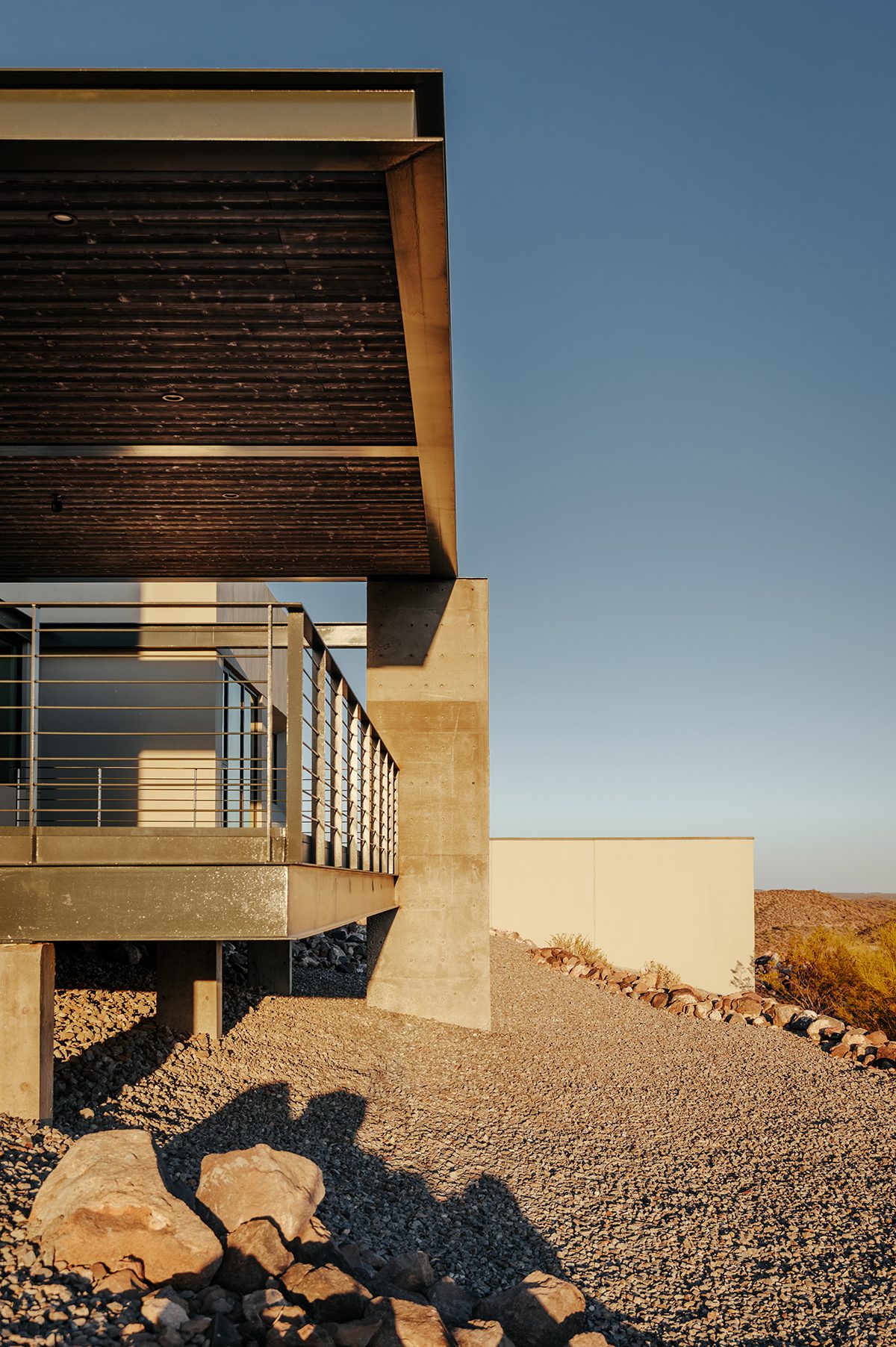
Perched along a natural ridge in Wickenburg, Arizona, the Horner Home is a custom modern residence. The site offers expansive views to the north overlooking Wickenburg and mountain vistas to the south, making this home a true example of site-integrated desert architecture. Designed to blend into the terrain, the Horner Home rests atop the ridge like a natural outcropping of boulders — grounded, intentional, and enduring. The architectural form is anchored by thick walls and deep-set overhangs, which shield the interior glass from the intensity of the desert sun, while still providing sweeping views and luminous interiors.
A House With Two Horizons
The Horner Home began with an unusual piece of land: a natural ridge above Wickenburg with views in opposite directions. To the north, the terrain falls away toward the town and the desert beyond. Turn south and the view changes to mountain. The clients wanted both. Their goal was a modern desert home that could occupy this exposed position without feeling like an object simply placed on top of the ridge. The house needed the permanence and protection appropriate to the site, but also the openness required to take advantage of its extraordinary position. It needed to hold the ridge. And it needed to look beyond it.
Building Along the Crest
A ridge has almost no neutral direction. Unlike a conventional desert lot, where a house might turn toward one dominant view and protect itself on the other sides, the Horner site is surrounded by landscape. Its narrow crest establishes a natural line through the property while the ground falls away in both directions. Spry Architecture used that line as the starting point. Rather than leveling the ridge and placing a house upon it, the architecture stretches along the existing landform. Heavy wall elements rise from the terrain like constructed outcroppings, establishing a sequence of solid forms along the crest. Between them, the landscape remains visible. North and south become equally important. Rooms don't simply terminate at exterior walls; they look through the architecture toward one horizon and, in places, across it toward another. The ridge isn't merely where the house sits. It is the line that draws the house.
Mass Below, Structure Above
Horner is composed from two very different architectural systems. At the ground, massive cast-in-place concrete forms give the house weight. They anchor the architecture to the ridge, define rooms, create privacy and provide a sense of shelter against an otherwise exposed landscape. Above them, the architecture becomes lighter. Wide-flange steel beams stretch between the concrete masses, supporting an exposed roof structure that appears to hover over the great room and outdoor living spaces. Instead of concealing the structure behind ceilings and finishes, the steel remains visible and becomes part of the spatial rhythm of the house. Concrete holds. Steel spans. Glass fills the space between them. That separation gives the house its character. The heavy elements seem to emerge from the ridge while the roof stretches lightly across them, allowing large areas of glass to open toward the surrounding views. The structural idea becomes the architectural expression. Nothing needs to pretend to be something else.
Building Weight, Making Shade
An exposed ridge offers extraordinary views—and very little protection. The Horner Home creates its own. Thick walls provide mass and enclosure while deep roof projections pull shade across the glass. The overhangs allow the house to remain visually open to the landscape while protecting interior spaces from the intensity of the Arizona sun. The same roof extends outward to shelter exterior living areas, creating a zone between conditioned space and open desert where the house can expand without losing protection. The material palette reinforces that environmental logic. Cast-in-place concrete has the visual weight of the surrounding geology. Jointed stucco introduces a finer scale and rhythm across the solid surfaces. Powder-coated wide-flange steel does the opposite: precise, linear and visibly structural. Glass occupies the intervals. Rather than covering those materials with another architectural language, Horner lets each remain legible—concrete as mass, steel as span, glass as opening. The desert provides enough texture of its own.
Water at the Edge of the Ridge
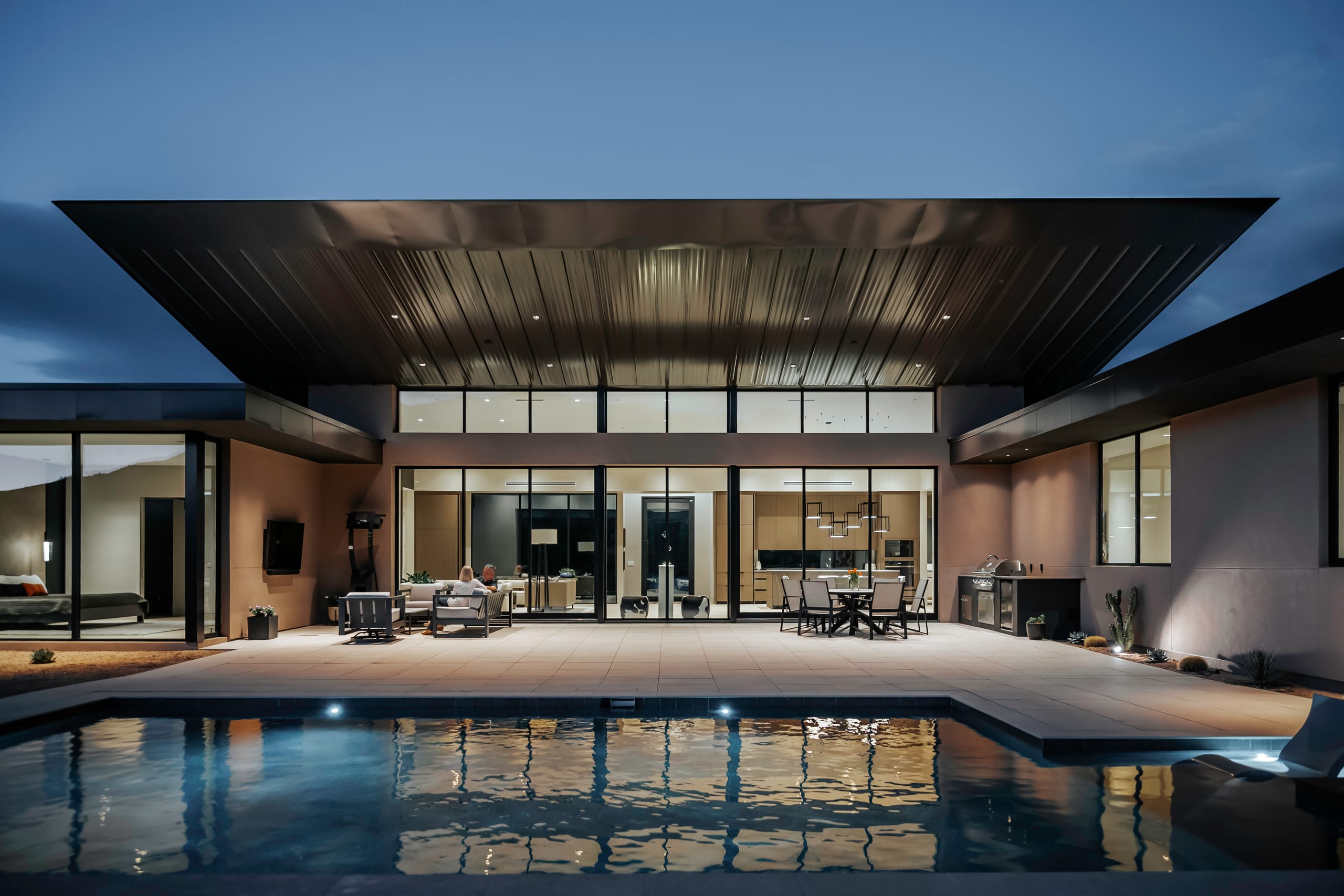
Inside Horner, the horizon is rarely in one direction. The house moves between views north across Wickenburg and south toward the mountains, with the exposed steel roof maintaining a continuous line overhead. Heavy concrete walls periodically interrupt the panorama, compressing the view before glass opens it again. Then the architecture reaches the edge. The outdoor living area extends from the great room beneath the same hovering roof structure, carrying the interior spatial order into the open air. Beyond it, a negative-edge pool occupies the ridge. Three sides disappear into infinity edges. From the water, pool, desert and sky begin to occupy the same plane. The edge of the architecture becomes difficult to locate, and the ridge seems to continue outward toward the horizon. Behind it, concrete gives the house permanence. Above it, steel gives the roof lightness. Between the two, glass keeps the landscape present. Horner doesn't simply take advantage of a mountaintop site. It turns the ridge itself into architecture.
Project Index & Credits
- Architecture Firm
- Spry Architecture
- Location
- Wickenburg, Arizona
- Completion Year
- 2022
- Area / Dimensions
- 4,400 sq ft
- General Contractor
- Dan Reardon
- Photography
- Virtue Visuals
Project Gallery (15)
“I can say that the design experience was rewarding and collaborative. Eric welcomed our ideas, listened to them, and often used his creative imagination to embellish our ideas into something even grander. When executing on a design for a home that has never been built before, you will encounter problems along the way. Eric applied his expertise and extensive resources to solve problems during the construction process so we could effectively accomplish our goals.”
Explore Comparable Works
Inspired by Horner Home?
Discuss your property, site topography, and custom modern residential vision directly with Eric Spry, AIA.