
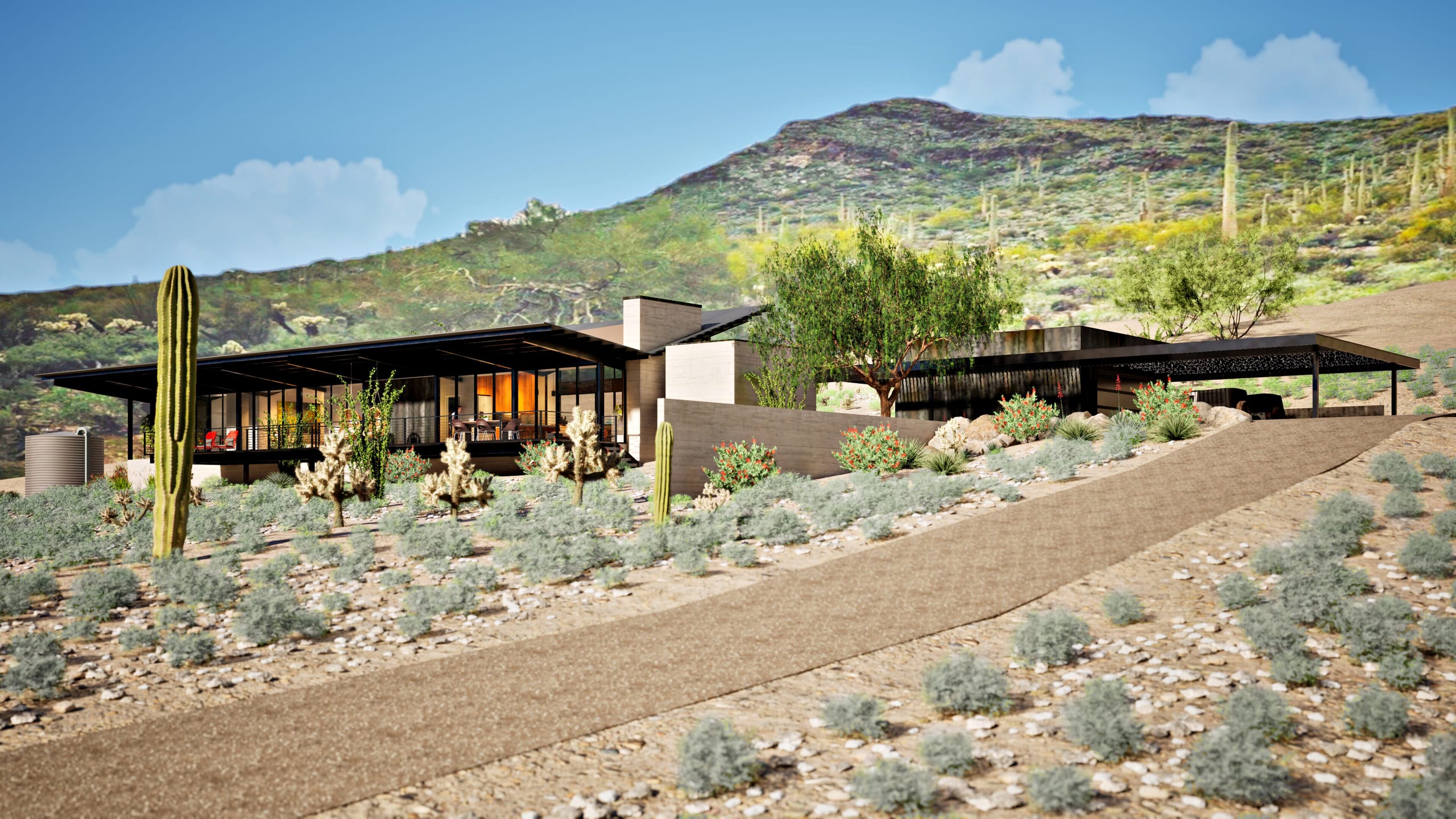
The Alder House is a modern home located in Cave Creek, Arizona, designed by Spry Architecture. Built into a rugged desert hillside, the home offers uninterrupted mountain views to the north, east, and south, fully embracing its elevated Sonoran Desert setting. Woven carefully into the land, the design responds to the site’s topography, solar exposure, and seasonal rhythms. Composed primarily of glass and natural materials, the Alder House is oriented to capture expansive desert views while maintaining a strong visual and sensory connection to the surrounding landscape.
A Modern House That Belongs to the Hill
The goal for the Alder Home was not simply to capture a view, but to live within one. Set high on a rugged hillside in Cave Creek, Arizona, the site opens toward mountains in three directions. The clients wanted a modern home that could take advantage of that extraordinary exposure without feeling perched above—or disconnected from—the desert below. The house needed openness and glass, but also weight. It needed to feel contemporary without becoming foreign to a landscape defined by stone, fractured terrain and intense Arizona light. The ambition was a house of contrasts: transparent yet grounded, expansive yet protected, modern in its geometry but unmistakably of the Sonoran Desert.
A House Drawn From the Geology
The hillside isn't a backdrop to the Alder Home. It is the beginning of the architecture. The site rises through native desert vegetation, exposed rock and the dark volcanic material characteristic of the Cave Creek landscape. From its elevated position, views extend north, east and south, giving the house an unusually broad relationship to the horizon. Rather than flatten that terrain into a conventional building pad, the architecture works with the slope. Long horizontal planes follow the land while areas of glass open outward toward the distant mountains. The geology also suggested a material language. Layers of exposed stone became the reference for horizontal board-formed concrete. Dark volcanic rock found across the site informed the charcoal-colored concrete masonry. The intention wasn't to reproduce nature literally, but to find an architectural equivalent for its weight, texture and stratification. The house comes from the hill before it rises above it.
Heavy Walls, Floating Planes
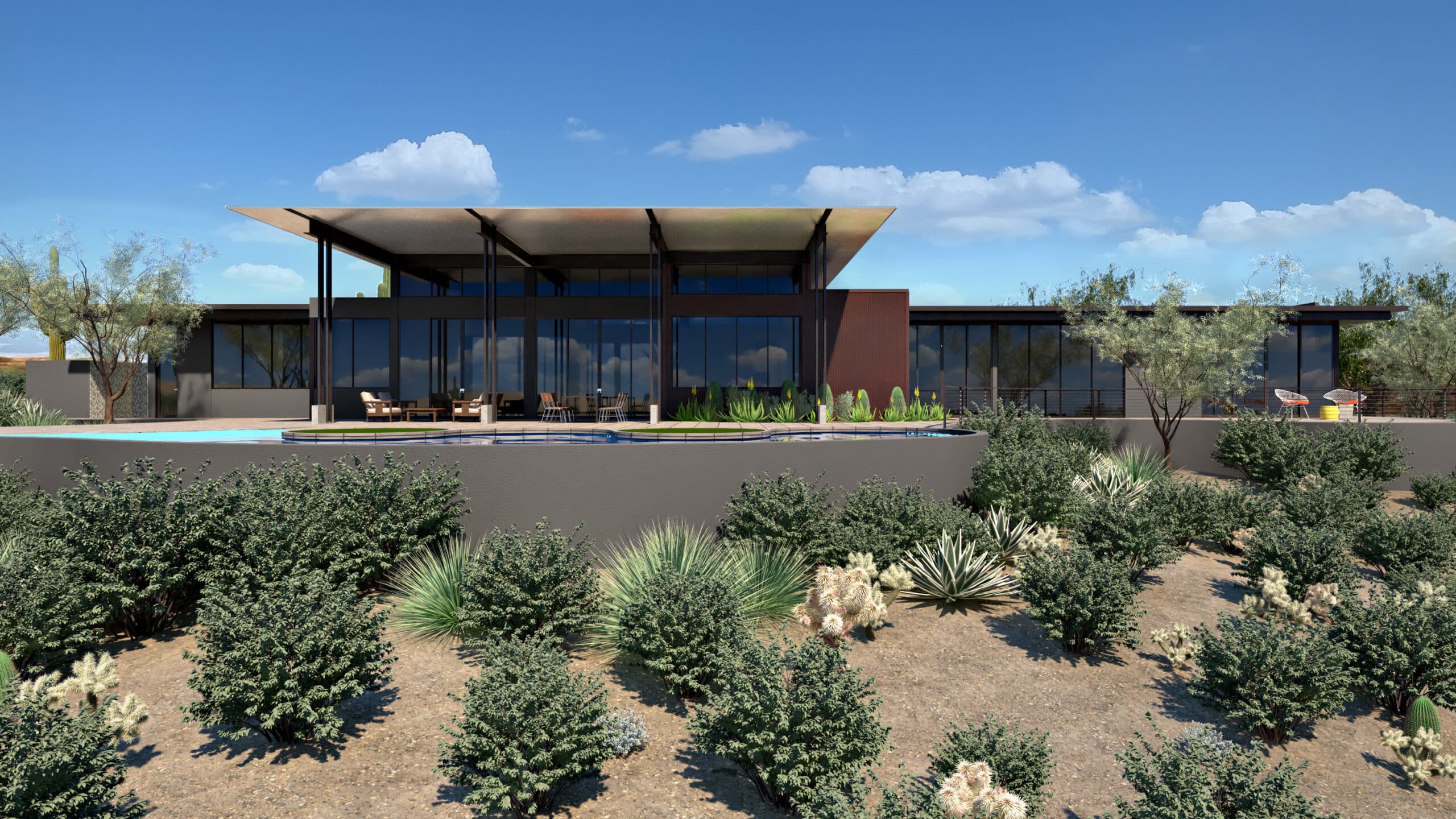
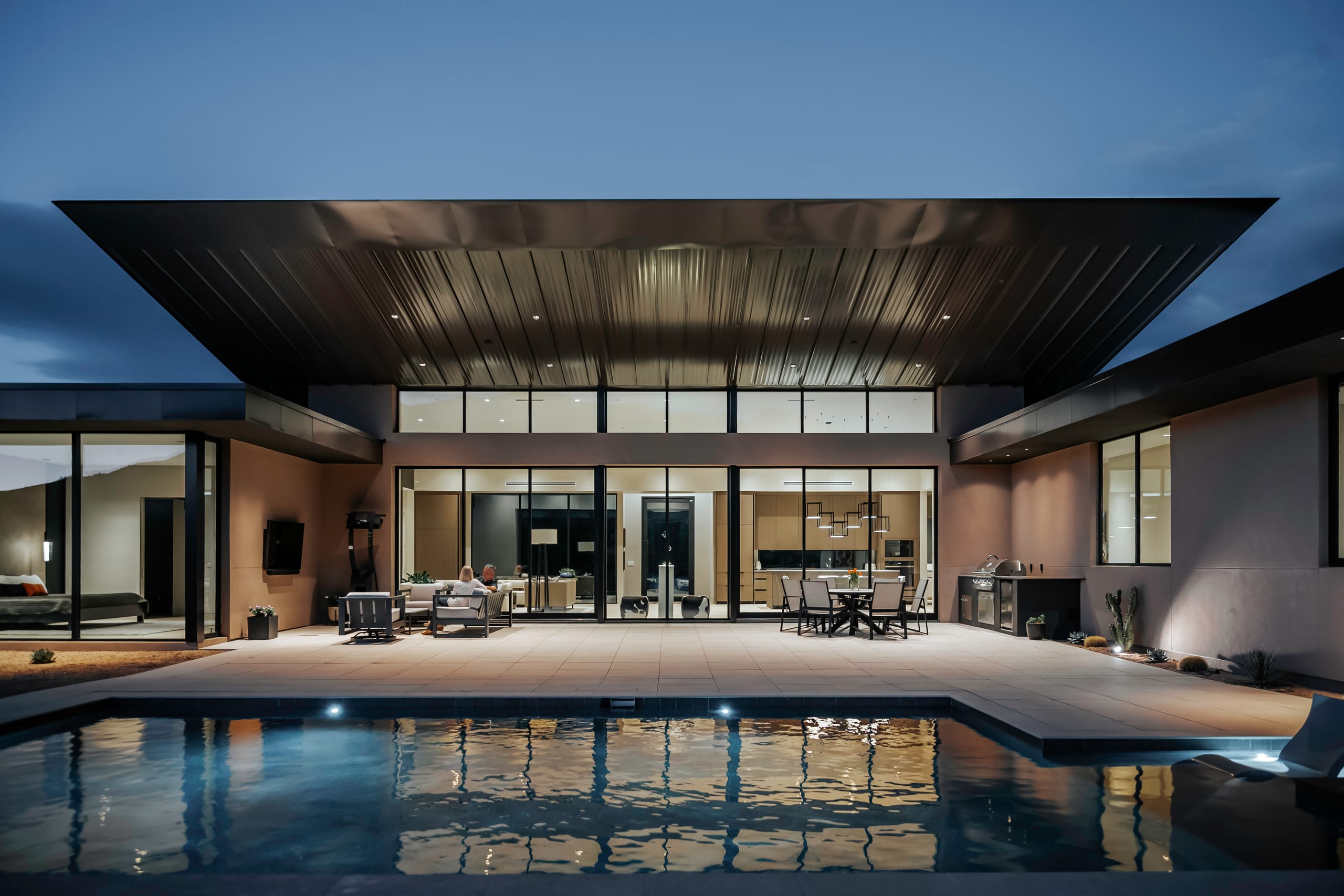
The Alder Home is composed through an intentional opposition of mass and transparency. Board-formed concrete and dark masonry walls anchor the house to the hillside. Between them, large planes of floor-to-ceiling glass pull the rooms outward toward the surrounding mountains. Heavy and light alternate. Solid walls hold the earth and establish privacy; glass releases the interior toward the horizon. Long roof planes extend beyond the enclosure, creating deep shadow lines that emphasize the home's horizontality and make the roof appear to float above the heavier forms below. The elevated site makes those extensions especially important. Instead of treating each view as a picture window, the architecture opens entire rooms toward the desert, allowing the landscape to move continuously across the interior. Even the photovoltaic array becomes architecture. Rather than hiding the solar panels on a conventional roof, Spry Architecture places them on an exposed steel structure above the carport. The array becomes the roof itself—energy infrastructure transformed into one of the home's visible architectural elements. Nothing is added merely to disguise what it does. Structure, enclosure and energy systems are allowed to participate in the composition.
Desert Performance Made Visible
In Cave Creek, shade is architecture. Deep roof overhangs project beyond the glass, protecting the interior from the intense Arizona sun while creating broad zones of exterior shade. The same gesture that sharpens the home's horizontal profile makes expansive glazing possible in a climate where unprotected glass would quickly become a liability. The photovoltaic canopy takes that environmental response one step further. Solar panels generate power while simultaneously forming a functional roof over the carport. Performance isn't concealed behind the architecture; it helps shape it. Material choices reinforce the relationship to place. Horizontal board-formed concrete carries the grain of its formwork while recalling the layered geology of the surrounding terrain. Charcoal-colored concrete block is sandblasted to expose a rougher surface, giving the walls a depth and texture closer to the dark volcanic rock scattered across the site. Steel and glass provide the counterpoint: thinner, lighter and more precise. The palette is intentionally limited. Concrete. Block. Steel. Glass. Against the complexity of the desert, the architecture becomes more elemental.
Between Stone and Horizon
The Alder Home is experienced between two scales of landscape. Close to the house are rock, concrete, shadow and desert vegetation. Beyond them, the land falls away and the horizon expands toward mountains to the north, east and south. The architecture moves constantly between the two. Solid walls create moments of enclosure before glass releases the room toward a distant view. Heavy materials hold the house to the hillside while roof planes extend beyond them. Deep shade gives way to the hard brilliance of the Arizona desert. From inside, the changing light and weather become part of the rooms. From outside, the home's horizontal concrete and masonry forms settle into the stratified terrain while glass and steel become progressively less substantial against the sky. Even the solar array participates in that experience—its exposed structure making visible something architecture often tries to hide. Alder doesn't sit on the hillside as an object. It takes its weight from the rock and its openness from the horizon.
Project Index & Credits
- Architecture Firm
- Spry Architecture
- Location
- Cave Creek, Arizona
- Completion Year
- 2027
- Area / Dimensions
- 4,000 sq ft
- General Contractor
- Applied Minds
- Photography
- Stephen SanMarco
Project Gallery (9)
“Their meticulous attention to craftsmanship, hillside integration, and structural elegance is unmatched in Arizona modern architecture. Eric guided us through complex hillside zoning and created our family’s forever sanctuary.”
Explore Comparable Works
Inspired by Alder Home?
Discuss your property, site topography, and custom modern residential vision directly with Eric Spry, AIA.